Explainable & Physics-Informed AI
Combining explainability and physical constraints in deep learning — from GeoPriorSubsNet v3 to lunar EM mapping — to build geohazard models that are accurate, interpretable, and physically consistent.
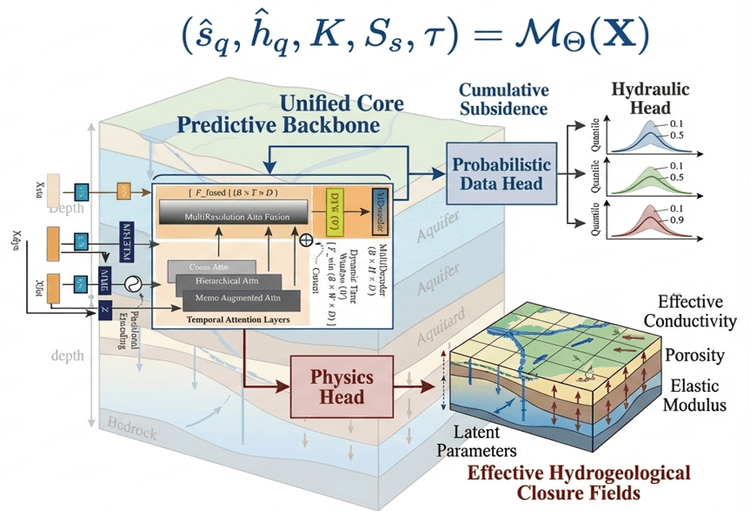
Data-Driven Learning
Multi-resolution attention fusion and encoder-decoder backbones that learn complex spatiotemporal patterns from InSAR, piezometric, and geological datasets.
Physics Heads
Dedicated physics head in GeoPriorSubsNet v3 recovers latent hydrogeological parameters — effective conductivity, porosity, elastic modulus — without extra supervision, enforcing physical plausibility at output time.
Uncertainty-Aware Evaluation
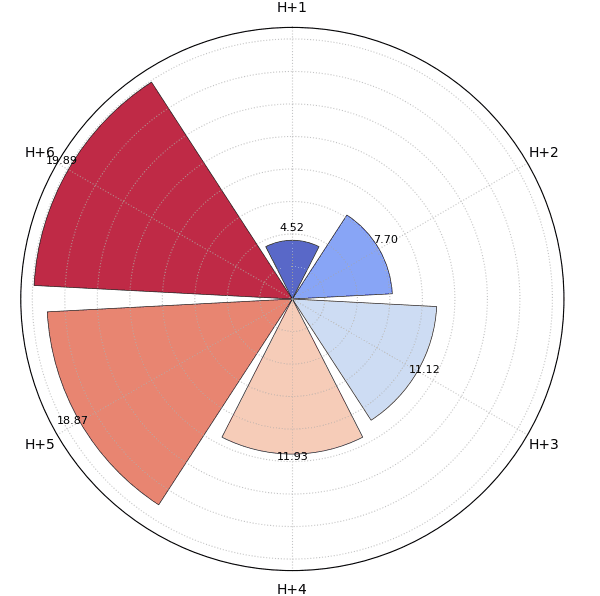
GeoPriorSubsNet's probabilistic outputs are audited with the k-diagram toolkit — ensuring that physical plausibility and statistical reliability go hand in hand across all quantile levels.
- Are physics-constrained forecasts better calibrated than data-only baselines?
- Do physics heads reduce physically implausible predictions?
- Where do data-physics trade-offs emerge in multi-city transfer?
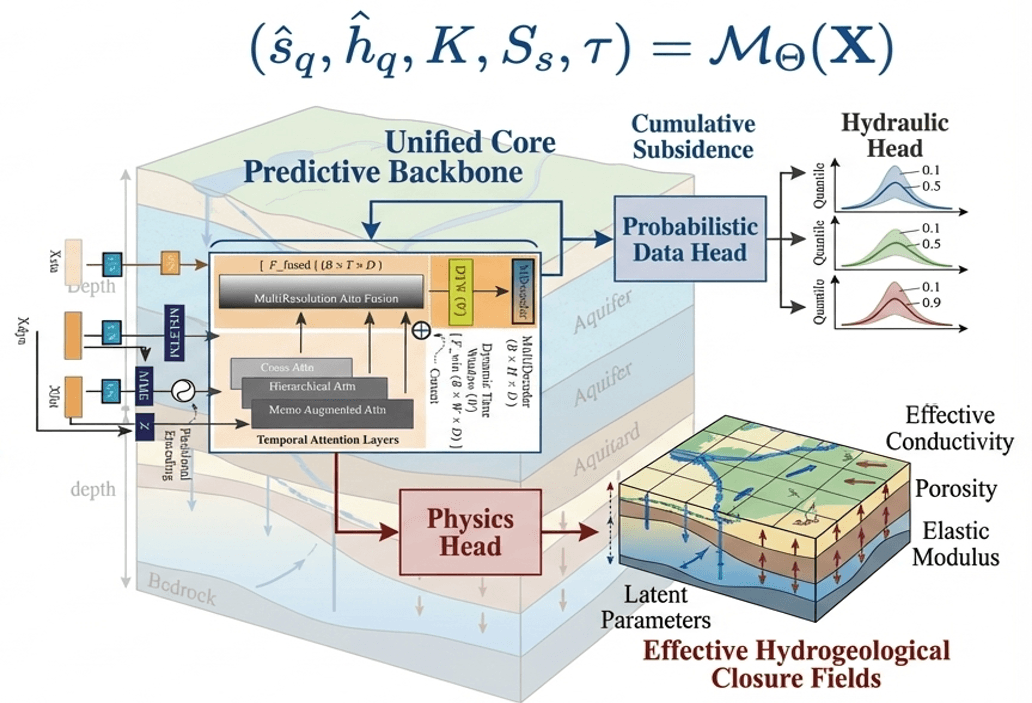
GeoPriorSubsNet v3: A Case Study in Physics-Guided AI
GeoPriorSubsNet v3 unifies a probabilistic data head (quantile outputs for cumulative subsidence and hydraulic head) with a physics head that recovers effective hydrogeological closure fields — conductivity, porosity, and elastic modulus — as latent variables. Trained on multi-city InSAR and piezometric data, it outperforms purely data-driven baselines and transfers across cities with minimal retraining.
The physics head acts as an implicit regularizer — it forces the model to learn representations that remain physically meaningful even under distribution shift across cities.
Lunar Titanium Mapping — EM + PINNs Beyond Earth
Physics-informed neural networks extend beyond terrestrial geohazards. As part of an international expert panel (NASA / JAXA / CNSA collaboration, 2025), I applied Maxwell-equation-constrained PINNs to multi-spectral electromagnetic (MXS) data from lunar surface surveys to map titanium-rich basalt distributions — a setting where physical constraints substitute for the dense ground-truth labels that are impossible to collect on the Moon.
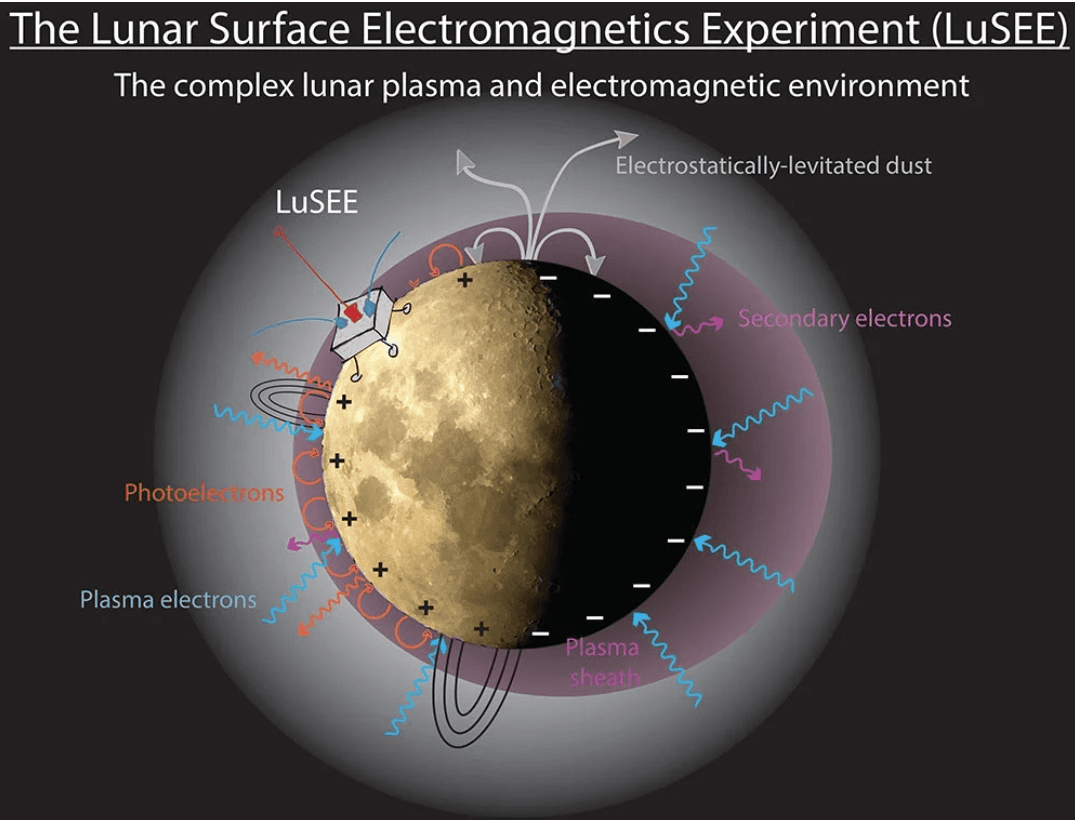
LuSEE — Lunar Surface Electromagnetics Experiment: the EM environment targeted by PINN-based titanium mapping
From Research to Practice
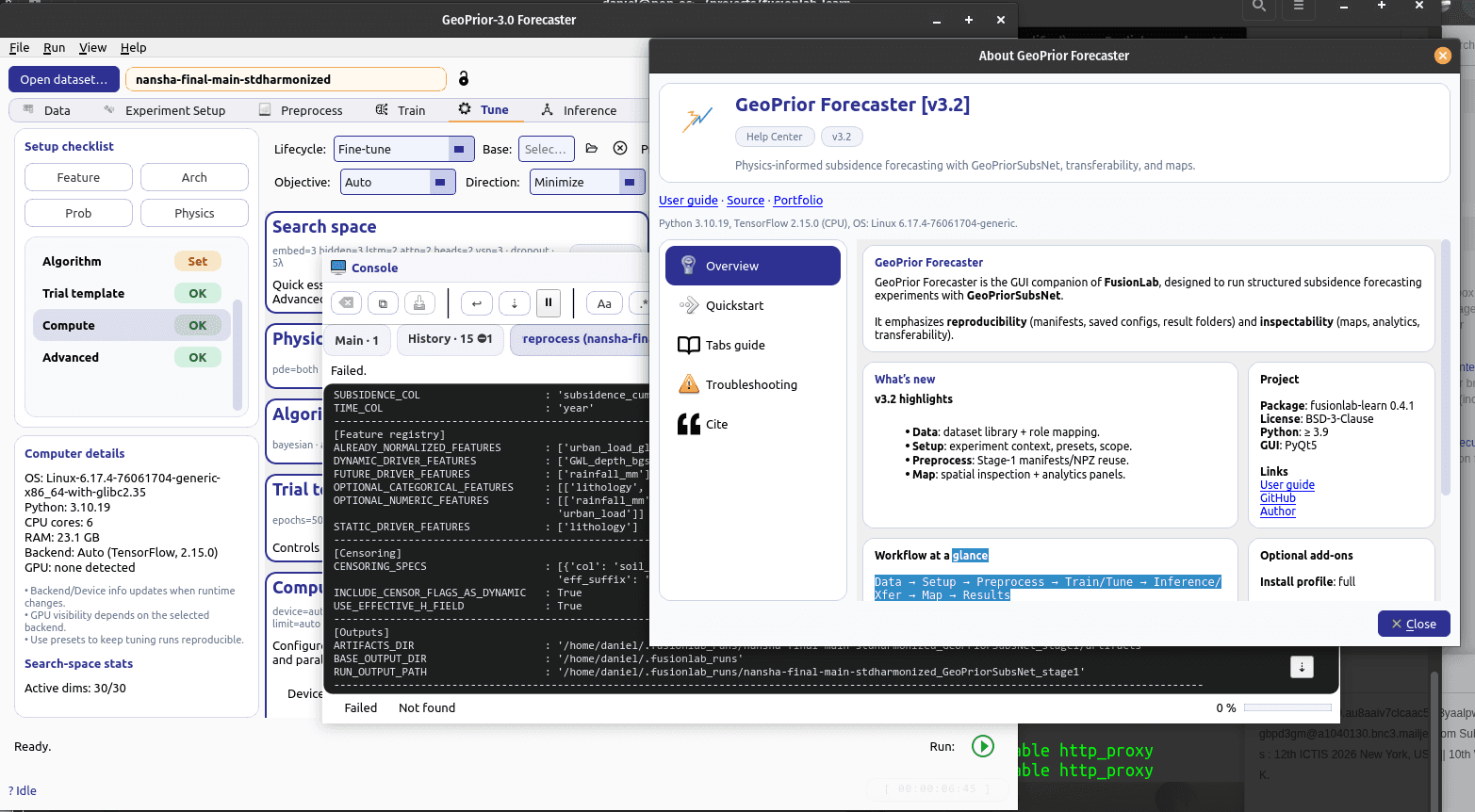
GeoPrior-3.0 Forecaster brings GeoPriorSubsNet to practitioners who don't write code — a desktop GUI that covers the full pipeline from data intake and physics-constraint configuration to training, transfer learning, and operational forecasting.
Impact
Key Research Outcomes
Papers in JOSS, IEEE TPAMI, JEM, and Nature Communications — spanning explainability, physics-informed AI, and uncertainty diagnostics.
XTFT (uncertainty-rich temporal fusion transformer) and GeoPriorSubsNet (physics + probabilistic heads) — novel architectures for geohazard forecasting.
GeoPrior-v3 and k-diagram released as installable Python packages with full documentation and reproducible tutorials.
PINN-based titanium mapping for the LuSEE lunar electromagnetics experiment — extending geophysical AI to extraterrestrial environments.
Open-Source
Software & Documentation
Publications
Related Work
Machine learning-based techniques for land subsidence simulation in an urban area
Liu, J.; Liu, W.; Allechy, F. B.; Zheng, Z.; Liu, R.; Kouadio, K. L.*
A diagnostic framework for interpreting spatiotemporal probabilistic forecasts
Kouadio, K. L.; Liu, R.; Loukou, K. G. H.; Liu, W.; Qing, Z.; Liu, Z.
Physics-Informed Deep Learning Reveals Divergent Urban Land Subsidence Regimes
Kouadio, K. L.; Liu, R.; Liu, Z.; Jiang, S.; Kouamelan, S.; Liu, W.; Qing, Z.; Zheng, Z.
Cluster-Aware Severity: Diagnosing Bursts of Prediction-Interval Violations
Kouadio, K. L.; Liu, R.
k-diagram: Rethinking Forecasting Uncertainty via Polar-Based Visualization
Kouadio, K. L.
k-diagram: Technical Report — Derivations and Details
Kouadio, K. L.