Land Subsidence Forecasting
Physics-informed deep learning with GeoPriorSubsNet to predict, quantify, and map urban ground deformation at scale.
Cities Are Sinking — and the Costs Are Accelerating
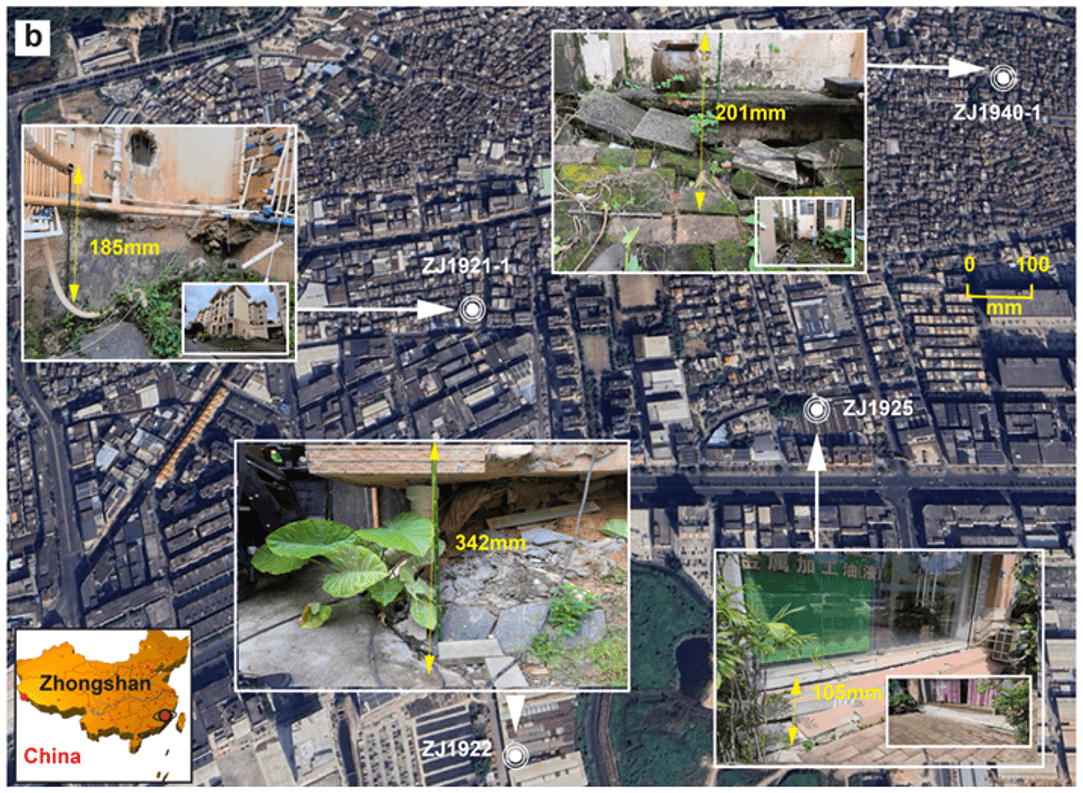
Uncontrolled groundwater extraction and rapid urbanization are causing measurable ground deformation in cities across southern China and beyond. Field surveys in Zhongshan reveal structural damage of 100–342 mm — cracked foundations, tilted buildings, broken pipes. Early, accurate forecasting is essential for sustainable urban planning.
GeoPriorSubsNet — Physics-Guided Forecasting Architecture
My work introduces GeoPriorSubsNet v3, a unified encoder-decoder backbone combining multi-resolution attention fusion, a probabilistic data head (quantile outputs for cumulative subsidence and hydraulic head), and a physics head that recovers latent hydrogeological parameters — effective conductivity, porosity, and elastic modulus — without extra labels.
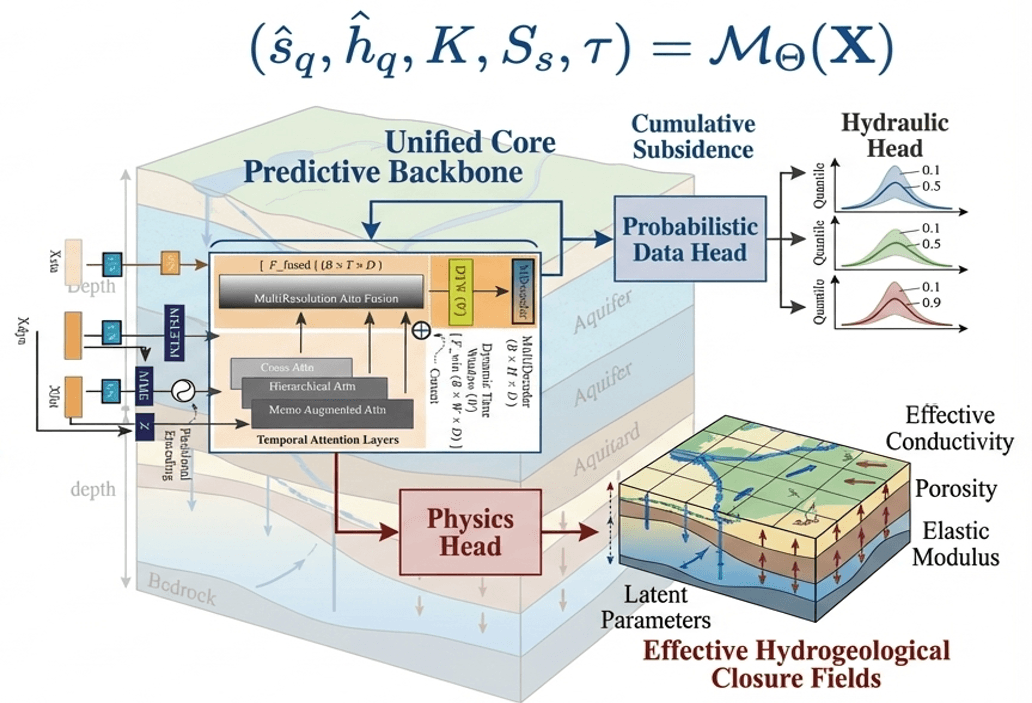
GeoPriorSubsNet architecture: unified predictive backbone with probabilistic and physics heads
Hotspot Persistence & Risk Maps
GeoPriorSubsNet outputs are translated into probabilistic risk maps that identify persistent subsidence hotspots across cities. Priority clusters ranked by mean risk score let urban planners focus intervention resources where deformation concentrates — turning model outputs into actionable intelligence.
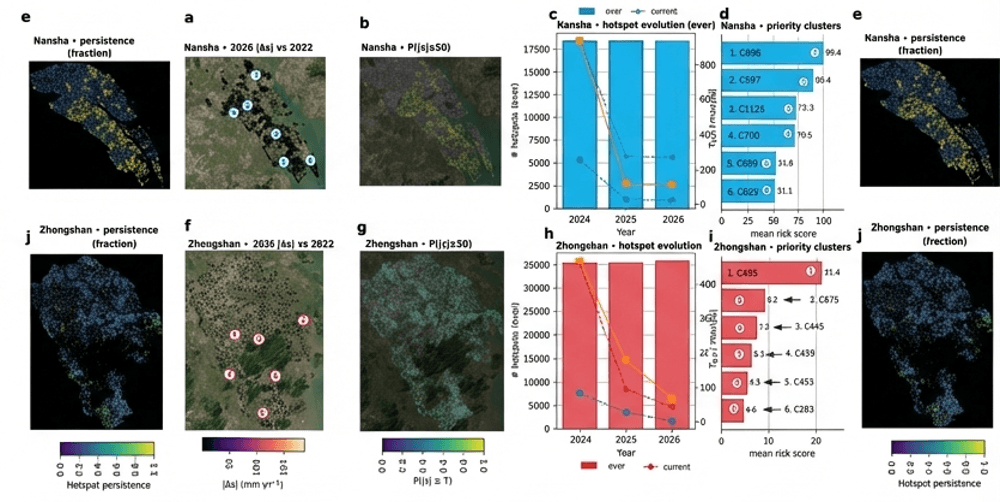
Nansha and Zhongshan hotspot evolution (2024–2026) and priority cluster rankings
Desktop Forecasting Suite
GeoPrior-3.0 Forecaster operationalizes GeoPriorSubsNet through a guided desktop environment — from data intake and experiment configuration to training, transfer learning, and operational forecasting — without requiring command-line skills.
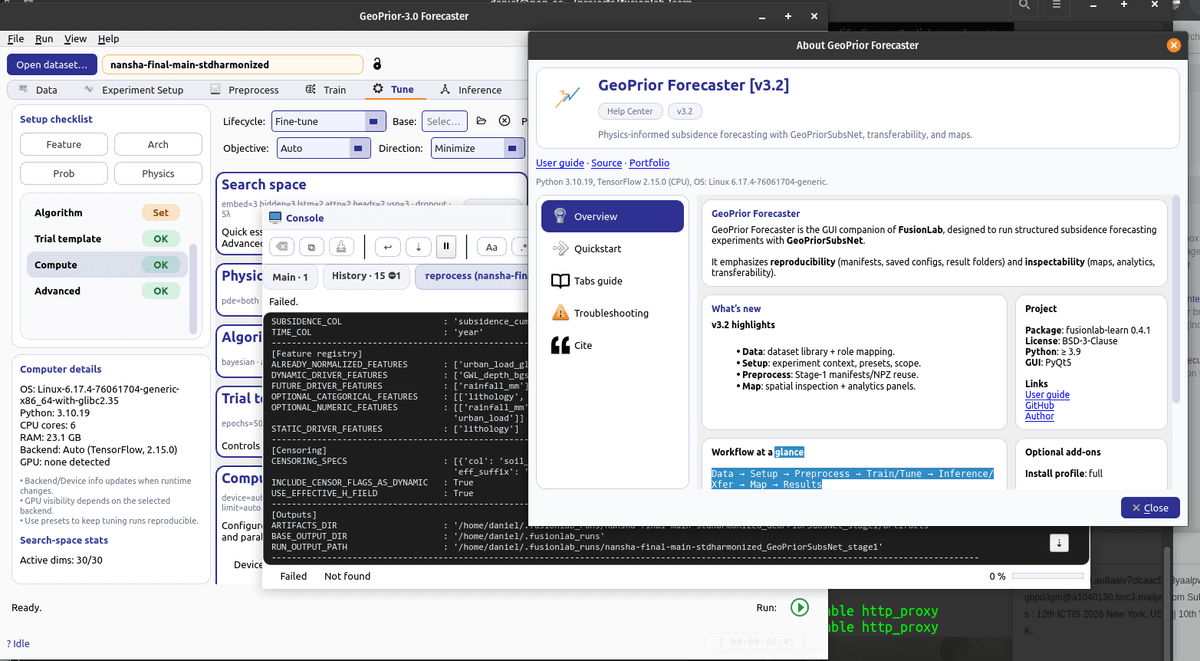
GeoPrior-3.0 Forecaster — desktop GUI for reproducible geohazard forecasting
Key Discoveries
Divergent Urban Regimes
Nansha and Zhongshan exhibit fundamentally different subsidence dynamics, requiring city-specific calibration rather than one-size-fits-all models.
Physics Improves Reliability
Embedding hydrogeological constraints reduces physically implausible predictions and recovers interpretable latent parameters without extra labels.
Transferable Across Cities
Models trained in one city can be transferred to a new deployment with minimal retraining, making multi-city rollout operationally feasible.
Impact
Key Research Outcomes
Papers in JEM, Nature Communications, IEEE TPAMI, Geophysics — plus a Chinese patent for physics-constrained subsidence forecasting.
Nansha and Zhongshan, China — multi-year InSAR time series converted into policy-ready subsidence hotspot and risk cluster maps.
GeoPrior-v3 released as a Python package — full physics-guided forecasting pipeline with built-in uncertainty quantification.
Chinese patent application (2026) for physics-constrained forecast inputs and closure-consistent urban land subsidence prediction.
Publications
Related Work
Machine learning-based techniques for land subsidence simulation in an urban area
Liu, J.; Liu, W.; Allechy, F. B.; Zheng, Z.; Liu, R.; Kouadio, K. L.*
Physics-Informed Deep Learning Reveals Divergent Urban Land Subsidence Regimes
Kouadio, K. L.; Liu, R.; Liu, Z.; Jiang, S.; Kouamelan, S.; Liu, W.; Qing, Z.; Zheng, Z.